Monday, April 17, 2017

Trunk chunks

This was a perfect day to ramble through our woods in search of a northern red oak. One of just the right diameter with just the right bark features. A small folding hand saw came in handy to fell the tree and then cut the trunk into 20 chunks, each about 5 inches tall. The bark shows the stretch marks with reddish inner bark. The cut edge shows the star-shaped pith and growth rings in heartwood and sapwood. My dad sanded all the sawed edges - once the chunks have dried out a bit, I'll seal one end to highlight the pith and rings. For now, a big slobber of saliva works pretty well.
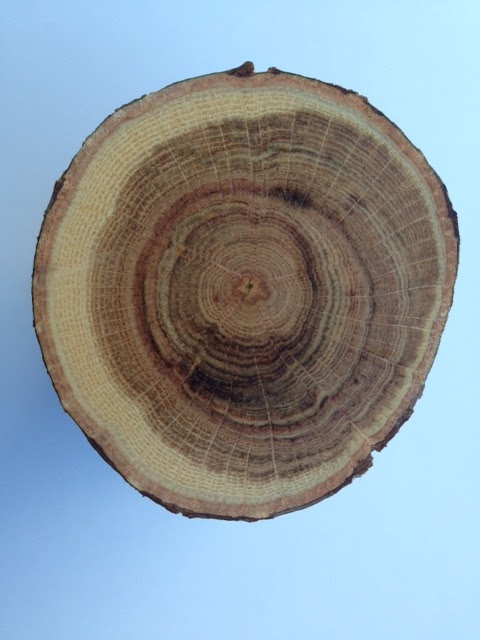


Update: I had a question and comment about the rings (thank you, Anthony). For those who read and wonder, there is a science to the counting and aging of trees and then relating that information to the conditions under which the tree grew. Tight growth rings suggest slow growth, widely spaced rings suggest more rapid growth, and a combination can indicate conditions (temperature and precipitation) that vary from year to year - this is the science of dendrochronology.

This particular tree has about 20 rings outside the inner star-shaped pith, then a weird band that is either wide but variegated or so tight that the rings cannot be counted. Between there and the cambium are another 20 or so layers. It will take some time and research, but now I'm curious to know what the temperature and precipitation trends were over the past 50 years - with particular interest in a major change around 1995-1997.

The other question/comment was whether it is possible to get some of this information by measuring the diameter of a tree. I understand that you might estimate the age of a tree this way, but it isn't nearly as accurate as counting rings or getting a core sample - nor does it shed light on the environmental conditions over the life of the tree.

Great questions. Anyone have another?

Friday, March 31, 2017

Kindred spirits

It's spring which means it's senior college season for me. The past couple of months have been busy with specimen collections, in-depth reading on tree topics, and organizing the collections. While it involves a good amount of time and effort, it is deeply satisfying for me. I learn more in the process, challenge my creative energies, and have at least one or two "aha" moments. Today I finally got to meet the class and learn all the ways that we are kindred spirits in the tree world. Time flew by (it always does) and it's only a week until we get to do it again. The senior college leadership really does a great job putting the program together, and I'm honored to be part of it again this year.

Wednesday, February 1, 2017

What is a tree?

Though easily recognizable by their general impression, size, and shape (GISS), have you ever thought about what it IS to be a tree? Trees can be described by their physical characteristics, categorized by their taxonomic place in the Kingdom of plants, and understood by their function and value in natural and human communities.

Physical Characteristics: Mature trees have a single woody stem, are taller than 15 feet, and have a trunk greater than 3 inches in diameter. Together, these three features set trees apart from shrubs (multiple woody stems, between 3-15 feet high, each trunk less than 3 inches) and other plants (wildflowers, ferns and fern allies, grass-like plants, and mosses). Young trees that spring up in dense groves might be confused with shrubs, and some trees barely exceed the height requirement even at maturity. Together though, these three criteria will almost always help distinguish trees from shrubs.

Taxonomy: Trees, like other living organisms, can be categorized and given a unique scientific name. At the top of the taxonomic hierarchy are four Kingdoms: plants, animals, fungi, and protists. Plants get divided into Divisions with trees falling into either Coniferophyta (cone-bearing) or Magnoliophyta (flower-bearing) groups. The groups continue to be divided into Class, Order, Family, and finally the Genus and Species.

The Genus and Species are the scientific (technical, botanical, Latin) name. For example, the common names sugar maple, rock maple, or hard maple are all the same tree with one unique scientific name: Acer saccharum. You'll notice that the scientific name is italicized - it can also be underlined (Acer saccharum) to alert the reader to its binomial nomenclature (two names). Acer is a genus in the Division of Magnoliophyta.

Magnoliophyta are deciduous, and the seeds develop inside an ovary to produce some type of fruit rather than a cone. There are 16 families of Magnoliophyta in Maine: Sapindacea (maple and horsechestnut), Oleacee (ash), Cornaceae (dogwood), Adoxaceae (viburnum), Betulaceae (birch, hornbean, hophornbeam, and alder), Salicaceae (willow and aspen), Hamamelidaceae (witch-hazel), Ulmaceae (elm), Malvaceae (tilia), Fagaceae (oak, beech, and chestnut), Juglandaceae (hickory and walnut), Platanaceae (sycamore), Lauraceae (sassafras), Rosaceae (cherry, hawthorn, shadbush, and mountain-ash), Fabacee (locust and honeylocust), and Ericaceae (laurel and rhododendron).

Coniferophyta are evergreens with seeds developing on the scales of cones - "naked" seeds since they don't have a fleshy exterior. In Maine, Coniferophyta are represented in two Families: Pinaceae (pine, fir, hemlock, spruce, and larch) and Cuppressaceae (white cedar, redcedar, and juniper).

Functions and Values: In a landscape, trees provide vertical structure and habitat for wildlife. Contributions to wildlife habitat include shelter and food, and large tracts of forest provide the large range needed for bigger animals. Trees filter light to influence ground cover and intercept rain to minimize erosion. Their extensive root structure holds soil in place, further minimizing erosion. For humans trees provide building material, pulp for paper, sap that boils down to maple syrup, turpentine from pine trees, and the astringent witch-hazel - to name just a few important products.

What is a tree to you?

Monday, January 30, 2017

Historical Creative Non-fiction: filling in the blanks

     Stories stay with folks. Whether they are oral traditions or written pieces ranging from a few words to full novels, facts are better remembered when put into the context of people, places, and events. Such it is with genealogical information. A list of names and dates is of little interest without a story about who they were and tales of their travels, near or far.
     But what do you do when there are only a few facts to piece a person together? Born, married, censused, parented, died. It's easy enough to weave in details like what was happening in the state's economy, whether there were wars or relative peace, or if health epidemics were prevalent. It's harder to know day-to-day details, and that's where I'm struggling to find the stories that bring life to past generations.
     I'm considering historical creative non-fiction as a genre. A historically sound and factual, non-fiction platform can give structure to the time period, family structure, and social concerns. Filling in the gaps, making assumptions based on the facts, that's where it gets creative.
     For someone like myself who feels compelled to provide evidence of every opinion or thought, it is a leap of faith to say, even to myself, "I think it could have happened this way, and there is no evidence to the contrary."
     So here goes everything. I'm drafting stories, sketches, about my ancestors as a way to compile the factual information I've found during my research as well as to round out their lives in a way that makes them more personally accessible - real people who lived full lives doing interesting things.

Saturday, November 26, 2016

Family Tree, Branching across the Country

The husband's family celebrates Thanksgiving in Virginia, and this year we decided to join them. I have an ancestral branch of the family that moved from Maine to Virginia in the 1850s so I also planned to do some research and visit some cemeteries. The research proved unproductive but I did learn quite a bit about the Civil War through some online articles and listening to the Washington Post's podcast Presidential. I also gained an appreciation of how far from home this family uprooted. However, even more productive than the research was the search for cemeteries and gravestones. 

The first cemetery, the Pohick Episcopal Church Cemetery in Lorton, VA was easy to access. Having seen a photo of the gravestone on Find-A-Grave, my eyes were honed in on a particular shape and a light color. It also helped to see a large family marker with the name "MORGAN" which is the married name of my great-great-great grandmother Flora Louise Chase. In addition to her stone, I also found several stones marking her children's final resting places.

The second stop was at the St. James Cemetery in Falls Church, VA. This was also easy to access, and again I had a Find-A-Grave photo to work with. Relatively small, it was easy enough for us to survey the entire cemetery but we came up empty. Looking again at the reference photo, I noticed that the stone was surrounded by oak leaves so we focused our search to the areas beneath the oaks. I remembered a stone that had been lifted by oak roots. Brushing dry leaves aside, I found Marion Genevieve Richard's stone bearing her married name "BROWN". Marion is my great-great grandmother.

Our third stop of the day was at the Congressional Cemetery in Washington DC. I had done my research at home and had a good idea which section of the cemetery I wanted - thank goodness, because this would have otherwise been impossible. We walked right to this distinctive double-marker stone. Before the Civil War, Thomas and Elvira Winship Chase lived in Farmington with their children where Thomas practiced law. After a few years in Chesterfield VA, they moved to Washington DC where they spent their remaining years.

It was quite a thrill to find all three cemeteries and an even greater sense of satisfaction to locate the gravestones. Though I've downloaded the Find-A-Grave photos, I now feel as though I've brought these distant relatives "home".

Tuesday, November 22, 2016

Thomas and Elvira Chase

Sometime in the 1850's Thomas Chase, a lawyer practicing in Farmington Maine, moved his family (wife Elvira and eight children) to be a farmer in Manchester in Chesterfield County Virginia. While in Virginia his daughter Flora fell in love with and married a Confederate soldier named Harney Napoleon Richard. Harney returned to his home state of Florida not knowing that Flora was pregnant. In 1866 Flora gave birth to a daughter Marion in Chesterfield and, believing that Harney had died since he never returned, remarried and had several more children. By 1880 Thomas and Elvira had settled in Washington DC. Flora, her new husband, their children, and Marion lived next door.

Flora and Harney's daughter was my great-great grandmother. I have many unanswered questions about this family: what pressed Thomas to leave Farmington; what drew him to Chesterfield; did Harney ever consider returning to Flora; did Flora ever try to reach Harney in Florida; what happened between 1866 and 1880; was Thomas content with his break from practicing law? 

After a morning at the Chesterfield Historical Society, three attempts to find local libraries with genealogy records, and an afternoon at the Library of Virginia in Richmond I am no closer to answering any of my questions - for today anyway. I'll continue to search online for clues, and some day I'll return to Chesterfield, hopefully armed with a few more details and direction. In the meantime, I met some lovely people, strengthened my resolve to discover more about my ancestors, and spent some much needed down-time with my husband's Chesterfield family who, like Thomas and Elvira, relocated from Maine. 

Saturday, September 24, 2016

Habits and Peculiarities

I love library book sales. Richard and I have developed the peculiar habit of seeking them out and spending hours poring over row upon row, table after table, of books. In addition to the sheer pleasure of being present to so many great works, this has proven to be a great way to add to my personal library of trees and natural history.

I love the sense of community that brings book lovers together, politely sidling past one another, waiting patiently to peruse THAT stack. I love the care taken to sort selections into categories, to handle each and every book so mindfully, and then place it where it is most likely to be found by its new reader. I love the watchful attendants who work the room straightening the field guides, tightening up the row of historical novels, tidying up the stories about animals. I love the check-out Friends of the Library who quickly tally the total while offering an extra bag to even out my load. I love that I can roam the room for hours, select anything that catches my fancy, and keep looking for just one more volume on my chosen interests. I love the inner satisfaction that I've supported a worthy cause - the Library - and I've supported another worthy cause - reading hard copy! And I love that, at the end of the day, I can curl up in the recliner and get lost in another good book.

Among the many titles I picked up this morning is "Our Native Trees and How to Identify Them: A Popular Study of Their Habits and Their Peculiarities" by Harriet Keeler. As if the first part of this title wouldn't grab my attention, how could I pass by the subtitle? Now to find more shelf space...