Monday, May 22, 2017

This weekend laid out the most beautiful blue skies as the perfect contrast to bright spring foliage. Among the various colors of green, one stood out from the others. A look around our neighborhood (and right in our front yard) quickly revealed its identity as Big-toothed Aspen (Populus grandidentata). Though most of the leaves are 40 feet above our heads, or more, there were enough within arms reach to confirm the broad leaf with the big, coarse teeth. 
We then wondered about the leafing schedule of the other two poplar species - Quaking Aspen (P. tremuloides) and Balsam Poplar (B. balsamifera). Quaking Aspen was also pretty easy since those are abundant on Walton Road - and trees of Big-tooth and Quaking Aspens have the dual personality mentioned in recently previous blog. Quaking Aspen leaves are already well-emerged and bright green, distinctly different from the grayish green of Big-tooths. It took a trip up north to check out the Balsam Poplar which conveniently grows along the interstate, and conveniently for me is right on my way to visiting the grandkids (and their parents, of course). So I was able to snap a photo of Balsam Poplar in full leaf and displaying a dual-natured bark like its cousins.

Saturday, May 20, 2017

Malus: close inspection of a perfect flower

Recent preparation for a class about the relationship between flowers and their fruits led me to collect an apple blossom (Malus spp.) for closer study. Apples are in the Rose family (Rosaceae) with the characteristics of having five flower parts and serrate-edged leaves. The flower is perfect because it has both the male stamens (filament and anther) and female pistils (stigma, style, and ovary) on a single blossom. The fruit, an apple, is a pome which consists of a fleshy receptacle and tough central core that houses the seeds. Slicing an apple in half (top to bottom) reveals these structures and slicing it in the other dimension (side to side) shows five sections. I was curious to know how the five sections corresponded with the stigma and style. A fruit with five fused sections (carpels) might have a single style with a five-lobed stigma at the top. The apple, I found, has five separate styles, each with a single-lobed stigma. Though it's a feature well suited for observation with a magnifying lens and not probably of much interest to the general public, it did help me better understand the flower, position of the receptacle, and the formation of the five sections that contain the seeds. I may or may not remember all of this when I'm savoring the juices and fleshy fruit but today, I'm happy to have taken the time to look at this perfectly lovely flower. 
serrate leaf edge                                   perfect flower with stamen & pistil

five pistils                                              five sepals

multiple stamens                                   inferior ovary

Dual Personality - poplar bark

Walking the Walton Road yesterday, I glanced into the woods and noticed several Quaking Aspens (Populus tremuloides) sporting their bark-of-two-natures. While the upper branches of most trees retain some of their younger, smoother features I can't think of another that displays young and old on the main trunk the way that poplar does.

As a young tree, poplar bark is grayish green with lenticels and markings similar to gray or paper birch. The greenish tinge is chlorophyll in its photosynthetic bark, capturing early sunshine in this pioneer species.

As poplar matures, the lower trunk develops stretch marks similar to northern red oak but without the reddish furrows. This is the stage at which many folks, myself included, can at eye level think that it's an oak.

Years later, the furrows lie between chunky ridges. The Maine Master Naturalist Program requires its students to choose a delimited site where we make regular observations. I had chosen a hollowed out piece of bark that turned out to be Big-toothed Aspen (P. grandidentata). As I watched activity around my delimited hollow stump, I noticed other  Big-toothed Aspens that had also dropped out of the canopy, a natural fate when these shade intolerant species are canopied by other species. Over time I became well acquainted with poplar's chunkiness topped by its smoother surface, a characteristic of both these poplar species.

Thursday, May 18, 2017

The Joker


This afternoon I happened to be passing by our old picnic table, gray with weather and hosting some British soldiers between the boards. My eye was drawn to something that looked a little out of place. Upon closer inspection, I found this moth garbed in camouflage. My iPhone Easy Macro lens captured the colors though I still have to practice with the focus. I attempted to use Google's reverse image feature without any luck, and no search results were yielded from "camouflage moth". Persistence paid off when I finally matched it up with an online photo of a Joker Moth, Faralia jocosa. The Joker is a forest moth that favors hemlock and balsam fir which are both common in our woods.

Wednesday, May 10, 2017

American Beech - the boys have done their job

Fellow naturalists found a beech flower on a recent ramble. I admit that I was a little bit envious, but also pretty excited to know that THIS is the time to look for them. American Beech (Fagus grandifolia) began leafing out a week or so ago, shedding it's soft orange bud scales as green unfolds - but I wasn't looking for flowers yet. Now alert, I have been scanning the ground beneath beech for a specimen to examine and to add to my ever expanding collection of all-things-tree.

Diligent observation pays off. I found a mother lode of beech flowers yesterday afternoon on a local trail, but only beneath a couple of the scores of trees I saw. I had to wonder, why did these trees drop so many flowers? 

The answer was obvious as soon as I looked closely with my hand lens - they were all staminate flowers with only male parts (anthers at the end of filaments). My mother lode had turned into a mac-daddy surprise. I'm guessing that these guys have released their pollen, done their job, and the tree no longer needs to expend its energy to maintain them. Energy will go toward the fertilized female flowers to develop into fruit. 

Now that I know where to look, you can bet that I'll be watching this set of trees for developments that will further my understanding of trees beyond the books. So exciting!

Oh, in case you're wondering how I got such a nice close-up of the anthers? I used my iPhone equipped with an Easy-Macro lens.

UPDATE: In addition to the strewn flowers, there were many short twigs with male flowers and a couple of leaves (shorter versions of the one pictured above. Upon closer inspection, the short twigs were broken at a 45-degree angle suggesting that some creature may have been responsible for the breakage. My engineer husband suggested the angle of the break could be to sheer stress. I haven't found any reference online for this phenomenon so I'm open to any ideas, dear readers. 

Wednesday, April 19, 2017

I'm sharing this opportunity to assist with planting American chestnut trees, it comes from the Nature Conservancy:

Can you volunteer to help bring back the American chestnut tree? We're planting nuts at the Basin Preserve starting at 9am this Friday (or Saturday if it rains) alongside our friends at The American Chestnut Foundation. If you're able to join for all or part of the day, please RSVP to Nancy Sferra at nsferra@tnc.org, and Nancy will provide further details. Hope to see you there!

Monday, April 17, 2017

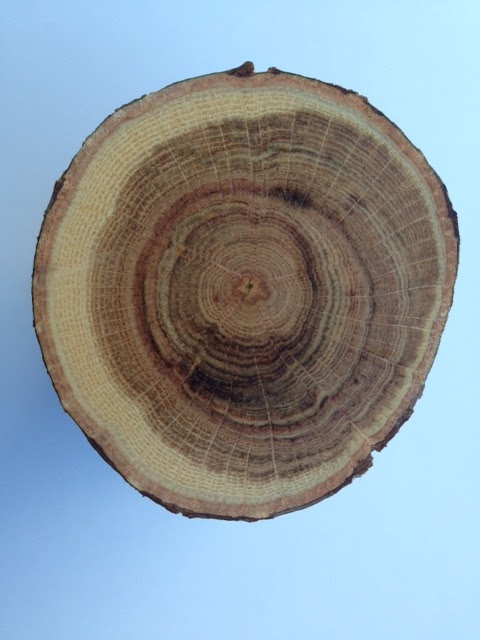
Trunk chunks

This was a perfect day to ramble through our woods in search of a northern red oak. One of just the right diameter with just the right bark features. A small folding hand saw came in handy to fell the tree and then cut the trunk into 20 chunks, each about 5 inches tall. The bark shows the stretch marks with reddish inner bark. The cut edge shows the star-shaped pith and growth rings in heartwood and sapwood. My dad sanded all the sawed edges - once the chunks have dried out a bit, I'll seal one end to highlight the pith and rings. For now, a big slobber of saliva works pretty well.


Update: I had a question and comment about the rings (thank you, Anthony). For those who read and wonder, there is a science to the counting and aging of trees and then relating that information to the conditions under which the tree grew. Tight growth rings suggest slow growth, widely spaced rings suggest more rapid growth, and a combination can indicate conditions (temperature and precipitation) that vary from year to year - this is the science of dendrochronology.

This particular tree has about 20 rings outside the inner star-shaped pith, then a weird band that is either wide but variegated or so tight that the rings cannot be counted. Between there and the cambium are another 20 or so layers. It will take some time and research, but now I'm curious to know what the temperature and precipitation trends were over the past 50 years - with particular interest in a major change around 1995-1997.

The other question/comment was whether it is possible to get some of this information by measuring the diameter of a tree. I understand that you might estimate the age of a tree this way, but it isn't nearly as accurate as counting rings or getting a core sample - nor does it shed light on the environmental conditions over the life of the tree.

Great questions. Anyone have another?