Saturday, June 17, 2017
Balsam Poplar
Monday, May 22, 2017
Saturday, May 20, 2017
Malus: close inspection of a perfect flower
serrate leaf edge perfect flower with stamen & pistil
five pistils five sepals
multiple stamens inferior ovary
Dual Personality - poplar bark
Walking the Walton Road yesterday, I glanced into the woods and noticed several Quaking Aspens (Populus tremuloides) sporting their bark-of-two-natures. While the upper branches of most trees retain some of their younger, smoother features I can't think of another that displays young and old on the main trunk the way that poplar does.As a young tree, poplar bark is grayish green with lenticels and markings similar to gray or paper birch. The greenish tinge is chlorophyll in its photosynthetic bark, capturing early sunshine in this pioneer species.
As poplar matures, the lower trunk develops stretch marks similar to northern red oak but without the reddish furrows. This is the stage at which many folks, myself included, can at eye level think that it's an oak.
Years later, the furrows lie between chunky ridges. The Maine Master Naturalist Program requires its students to choose a delimited site where we make regular observations. I had chosen a hollowed out piece of bark that turned out to be Big-toothed Aspen (P. grandidentata). As I watched activity around my delimited hollow stump, I noticed other Big-toothed Aspens that had also dropped out of the canopy, a natural fate when these shade intolerant species are canopied by other species. Over time I became well acquainted with poplar's chunkiness topped by its smoother surface, a characteristic of both these poplar species.
Thursday, May 18, 2017
The Joker
This afternoon I happened to be passing by our old picnic table, gray with weather and hosting some British soldiers between the boards. My eye was drawn to something that looked a little out of place. Upon closer inspection, I found this moth garbed in camouflage. My iPhone Easy Macro lens captured the colors though I still have to practice with the focus. I attempted to use Google's reverse image feature without any luck, and no search results were yielded from "camouflage moth". Persistence paid off when I finally matched it up with an online photo of a Joker Moth, Faralia jocosa. The Joker is a forest moth that favors hemlock and balsam fir which are both common in our woods.
Wednesday, May 10, 2017
American Beech - the boys have done their job
Fellow naturalists found a beech flower on a recent ramble. I admit that I was a little bit envious, but also pretty excited to know that THIS is the time to look for them. American Beech (Fagus grandifolia) began leafing out a week or so ago, shedding it's soft orange bud scales as green unfolds - but I wasn't looking for flowers yet. Now alert, I have been scanning the ground beneath beech for a specimen to examine and to add to my ever expanding collection of all-things-tree.
The answer was obvious as soon as I looked closely with my hand lens - they were all staminate flowers with only male parts (anthers at the end of filaments). My mother lode had turned into a mac-daddy surprise. I'm guessing that these guys have released their pollen, done their job, and the tree no longer needs to expend its energy to maintain them. Energy will go toward the fertilized female flowers to develop into fruit.
Diligent observation pays off. I found a mother lode of beech flowers yesterday afternoon on a local trail, but only beneath a couple of the scores of trees I saw. I had to wonder, why did these trees drop so many flowers?
Now that I know where to look, you can bet that I'll be watching this set of trees for developments that will further my understanding of trees beyond the books. So exciting!
Oh, in case you're wondering how I got such a nice close-up of the anthers? I used my iPhone equipped with an Easy-Macro lens.
UPDATE: In addition to the strewn flowers, there were many short twigs with male flowers and a couple of leaves (shorter versions of the one pictured above. Upon closer inspection, the short twigs were broken at a 45-degree angle suggesting that some creature may have been responsible for the breakage. My engineer husband suggested the angle of the break could be to sheer stress. I haven't found any reference online for this phenomenon so I'm open to any ideas, dear readers.
Wednesday, April 19, 2017
I'm sharing this opportunity to assist with planting American chestnut trees, it comes from the Nature Conservancy:
Can you volunteer to help bring back the American chestnut tree? We're planting nuts at the Basin Preserve starting at 9am this Friday (or Saturday if it rains) alongside our friends at The American Chestnut Foundation. If you're able to join for all or part of the day, please RSVP to Nancy Sferra at nsferra@tnc.org, and Nancy will provide further details. Hope to see you there!
Monday, April 17, 2017
Trunk chunks
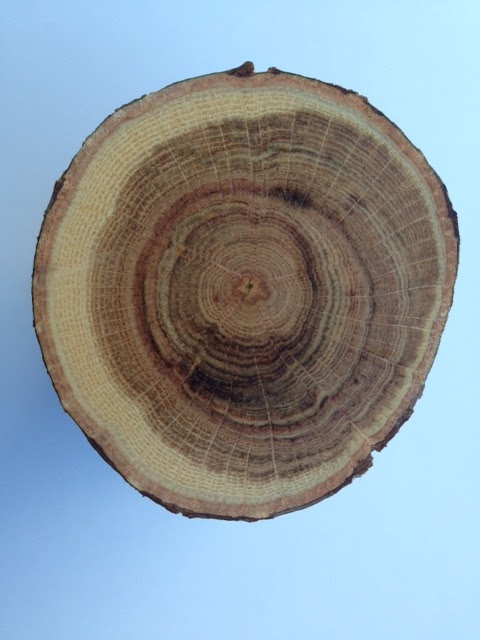
This was a perfect day to ramble through our woods in search of a northern red oak. One of just the right diameter with just the right bark features. A small folding hand saw came in handy to fell the tree and then cut the trunk into 20 chunks, each about 5 inches tall. The bark shows the stretch marks with reddish inner bark. The cut edge shows the star-shaped pith and growth rings in heartwood and sapwood. My dad sanded all the sawed edges - once the chunks have dried out a bit, I'll seal one end to highlight the pith and rings. For now, a big slobber of saliva works pretty well.


Update: I had a question and comment about the rings (thank you, Anthony). For those who read and wonder, there is a science to the counting and aging of trees and then relating that information to the conditions under which the tree grew. Tight growth rings suggest slow growth, widely spaced rings suggest more rapid growth, and a combination can indicate conditions (temperature and precipitation) that vary from year to year - this is the science of dendrochronology.
This particular tree has about 20 rings outside the inner star-shaped pith, then a weird band that is either wide but variegated or so tight that the rings cannot be counted. Between there and the cambium are another 20 or so layers. It will take some time and research, but now I'm curious to know what the temperature and precipitation trends were over the past 50 years - with particular interest in a major change around 1995-1997.
The other question/comment was whether it is possible to get some of this information by measuring the diameter of a tree. I understand that you might estimate the age of a tree this way, but it isn't nearly as accurate as counting rings or getting a core sample - nor does it shed light on the environmental conditions over the life of the tree.
Great questions. Anyone have another?
Friday, March 31, 2017
Kindred spirits
It's spring which means it's senior college season for me. The past couple of months have been busy with specimen collections, in-depth reading on tree topics, and organizing the collections. While it involves a good amount of time and effort, it is deeply satisfying for me. I learn more in the process, challenge my creative energies, and have at least one or two "aha" moments. Today I finally got to meet the class and learn all the ways that we are kindred spirits in the tree world. Time flew by (it always does) and it's only a week until we get to do it again. The senior college leadership really does a great job putting the program together, and I'm honored to be part of it again this year.
Wednesday, February 1, 2017
What is a tree?
Though easily recognizable by their general impression, size, and shape (GISS), have you ever thought about what it IS to be a tree? Trees can be described by their physical characteristics, categorized by their taxonomic place in the Kingdom of plants, and understood by their function and value in natural and human communities.
Physical Characteristics: Mature trees have a single woody stem, are taller than 15 feet, and have a trunk greater than 3 inches in diameter. Together, these three features set trees apart from shrubs (multiple woody stems, between 3-15 feet high, each trunk less than 3 inches) and other plants (wildflowers, ferns and fern allies, grass-like plants, and mosses). Young trees that spring up in dense groves might be confused with shrubs, and some trees barely exceed the height requirement even at maturity. Together though, these three criteria will almost always help distinguish trees from shrubs.
Taxonomy: Trees, like other living organisms, can be categorized and given a unique scientific name. At the top of the taxonomic hierarchy are four Kingdoms: plants, animals, fungi, and protists. Plants get divided into Divisions with trees falling into either Coniferophyta (cone-bearing) or Magnoliophyta (flower-bearing) groups. The groups continue to be divided into Class, Order, Family, and finally the Genus and Species.
The Genus and Species are the scientific (technical, botanical, Latin) name. For example, the common names sugar maple, rock maple, or hard maple are all the same tree with one unique scientific name: Acer saccharum. You'll notice that the scientific name is italicized - it can also be underlined (Acer saccharum) to alert the reader to its binomial nomenclature (two names). Acer is a genus in the Division of Magnoliophyta.
Magnoliophyta are deciduous, and the seeds develop inside an ovary to produce some type of fruit rather than a cone. There are 16 families of Magnoliophyta in Maine: Sapindacea (maple and horsechestnut), Oleacee (ash), Cornaceae (dogwood), Adoxaceae (viburnum), Betulaceae (birch, hornbean, hophornbeam, and alder), Salicaceae (willow and aspen), Hamamelidaceae (witch-hazel), Ulmaceae (elm), Malvaceae (tilia), Fagaceae (oak, beech, and chestnut), Juglandaceae (hickory and walnut), Platanaceae (sycamore), Lauraceae (sassafras), Rosaceae (cherry, hawthorn, shadbush, and mountain-ash), Fabacee (locust and honeylocust), and Ericaceae (laurel and rhododendron).
Coniferophyta are evergreens with seeds developing on the scales of cones - "naked" seeds since they don't have a fleshy exterior. In Maine, Coniferophyta are represented in two Families: Pinaceae (pine, fir, hemlock, spruce, and larch) and Cuppressaceae (white cedar, redcedar, and juniper).
Functions and Values: In a landscape, trees provide vertical structure and habitat for wildlife. Contributions to wildlife habitat include shelter and food, and large tracts of forest provide the large range needed for bigger animals. Trees filter light to influence ground cover and intercept rain to minimize erosion. Their extensive root structure holds soil in place, further minimizing erosion. For humans trees provide building material, pulp for paper, sap that boils down to maple syrup, turpentine from pine trees, and the astringent witch-hazel - to name just a few important products.
What is a tree to you?
Physical Characteristics: Mature trees have a single woody stem, are taller than 15 feet, and have a trunk greater than 3 inches in diameter. Together, these three features set trees apart from shrubs (multiple woody stems, between 3-15 feet high, each trunk less than 3 inches) and other plants (wildflowers, ferns and fern allies, grass-like plants, and mosses). Young trees that spring up in dense groves might be confused with shrubs, and some trees barely exceed the height requirement even at maturity. Together though, these three criteria will almost always help distinguish trees from shrubs.
Taxonomy: Trees, like other living organisms, can be categorized and given a unique scientific name. At the top of the taxonomic hierarchy are four Kingdoms: plants, animals, fungi, and protists. Plants get divided into Divisions with trees falling into either Coniferophyta (cone-bearing) or Magnoliophyta (flower-bearing) groups. The groups continue to be divided into Class, Order, Family, and finally the Genus and Species.
The Genus and Species are the scientific (technical, botanical, Latin) name. For example, the common names sugar maple, rock maple, or hard maple are all the same tree with one unique scientific name: Acer saccharum. You'll notice that the scientific name is italicized - it can also be underlined (Acer saccharum) to alert the reader to its binomial nomenclature (two names). Acer is a genus in the Division of Magnoliophyta.
Magnoliophyta are deciduous, and the seeds develop inside an ovary to produce some type of fruit rather than a cone. There are 16 families of Magnoliophyta in Maine: Sapindacea (maple and horsechestnut), Oleacee (ash), Cornaceae (dogwood), Adoxaceae (viburnum), Betulaceae (birch, hornbean, hophornbeam, and alder), Salicaceae (willow and aspen), Hamamelidaceae (witch-hazel), Ulmaceae (elm), Malvaceae (tilia), Fagaceae (oak, beech, and chestnut), Juglandaceae (hickory and walnut), Platanaceae (sycamore), Lauraceae (sassafras), Rosaceae (cherry, hawthorn, shadbush, and mountain-ash), Fabacee (locust and honeylocust), and Ericaceae (laurel and rhododendron).
Coniferophyta are evergreens with seeds developing on the scales of cones - "naked" seeds since they don't have a fleshy exterior. In Maine, Coniferophyta are represented in two Families: Pinaceae (pine, fir, hemlock, spruce, and larch) and Cuppressaceae (white cedar, redcedar, and juniper).
Functions and Values: In a landscape, trees provide vertical structure and habitat for wildlife. Contributions to wildlife habitat include shelter and food, and large tracts of forest provide the large range needed for bigger animals. Trees filter light to influence ground cover and intercept rain to minimize erosion. Their extensive root structure holds soil in place, further minimizing erosion. For humans trees provide building material, pulp for paper, sap that boils down to maple syrup, turpentine from pine trees, and the astringent witch-hazel - to name just a few important products.
What is a tree to you?
Monday, January 30, 2017
Historical Creative Non-fiction: filling in the blanks
Stories stay with folks. Whether they are oral traditions or written pieces ranging from a few words to full novels, facts are better remembered when put into the context of people, places, and events. Such it is with genealogical information. A list of names and dates is of little interest without a story about who they were and tales of their travels, near or far.
But what do you do when there are only a few facts to piece a person together? Born, married, censused, parented, died. It's easy enough to weave in details like what was happening in the state's economy, whether there were wars or relative peace, or if health epidemics were prevalent. It's harder to know day-to-day details, and that's where I'm struggling to find the stories that bring life to past generations.
I'm considering historical creative non-fiction as a genre. A historically sound and factual, non-fiction platform can give structure to the time period, family structure, and social concerns. Filling in the gaps, making assumptions based on the facts, that's where it gets creative.
For someone like myself who feels compelled to provide evidence of every opinion or thought, it is a leap of faith to say, even to myself, "I think it could have happened this way, and there is no evidence to the contrary."
So here goes everything. I'm drafting stories, sketches, about my ancestors as a way to compile the factual information I've found during my research as well as to round out their lives in a way that makes them more personally accessible - real people who lived full lives doing interesting things.
But what do you do when there are only a few facts to piece a person together? Born, married, censused, parented, died. It's easy enough to weave in details like what was happening in the state's economy, whether there were wars or relative peace, or if health epidemics were prevalent. It's harder to know day-to-day details, and that's where I'm struggling to find the stories that bring life to past generations.
I'm considering historical creative non-fiction as a genre. A historically sound and factual, non-fiction platform can give structure to the time period, family structure, and social concerns. Filling in the gaps, making assumptions based on the facts, that's where it gets creative.
For someone like myself who feels compelled to provide evidence of every opinion or thought, it is a leap of faith to say, even to myself, "I think it could have happened this way, and there is no evidence to the contrary."
So here goes everything. I'm drafting stories, sketches, about my ancestors as a way to compile the factual information I've found during my research as well as to round out their lives in a way that makes them more personally accessible - real people who lived full lives doing interesting things.
Saturday, November 26, 2016
Family Tree, Branching across the Country
The husband's family celebrates Thanksgiving in Virginia, and this year we decided to join them. I have an ancestral branch of the family that moved from Maine to Virginia in the 1850s so I also planned to do some research and visit some cemeteries. The research proved unproductive but I did learn quite a bit about the Civil War through some online articles and listening to the Washington Post's podcast Presidential. I also gained an appreciation of how far from home this family uprooted. However, even more productive than the research was the search for cemeteries and gravestones.
The second stop was at the St. James Cemetery in Falls Church, VA. This was also easy to access, and again I had a Find-A-Grave photo to work with. Relatively small, it was easy enough for us to survey the entire cemetery but we came up empty. Looking again at the reference photo, I noticed that the stone was surrounded by oak leaves so we focused our search to the areas beneath the oaks. I remembered a stone that had been lifted by oak roots. Brushing dry leaves aside, I found Marion Genevieve Richard's stone bearing her married name "BROWN". Marion is my great-great grandmother.
Our third stop of the day was at the Congressional Cemetery in Washington DC. I had done my research at home and had a good idea which section of the cemetery I wanted - thank goodness, because this would have otherwise been impossible. We walked right to this distinctive double-marker stone. Before the Civil War, Thomas and Elvira Winship Chase lived in Farmington with their children where Thomas practiced law. After a few years in Chesterfield VA, they moved to Washington DC where they spent their remaining years.It was quite a thrill to find all three cemeteries and an even greater sense of satisfaction to locate the gravestones. Though I've downloaded the Find-A-Grave photos, I now feel as though I've brought these distant relatives "home".
Tuesday, November 22, 2016
Thomas and Elvira Chase
Sometime in the 1850's Thomas Chase, a lawyer practicing in Farmington Maine, moved his family (wife Elvira and eight children) to be a farmer in Manchester in Chesterfield County Virginia. While in Virginia his daughter Flora fell in love with and married a Confederate soldier named Harney Napoleon Richard. Harney returned to his home state of Florida not knowing that Flora was pregnant. In 1866 Flora gave birth to a daughter Marion in Chesterfield and, believing that Harney had died since he never returned, remarried and had several more children. By 1880 Thomas and Elvira had settled in Washington DC. Flora, her new husband, their children, and Marion lived next door.
Flora and Harney's daughter was my great-great grandmother. I have many unanswered questions about this family: what pressed Thomas to leave Farmington; what drew him to Chesterfield; did Harney ever consider returning to Flora; did Flora ever try to reach Harney in Florida; what happened between 1866 and 1880; was Thomas content with his break from practicing law?
After a morning at the Chesterfield Historical Society, three attempts to find local libraries with genealogy records, and an afternoon at the Library of Virginia in Richmond I am no closer to answering any of my questions - for today anyway. I'll continue to search online for clues, and some day I'll return to Chesterfield, hopefully armed with a few more details and direction. In the meantime, I met some lovely people, strengthened my resolve to discover more about my ancestors, and spent some much needed down-time with my husband's Chesterfield family who, like Thomas and Elvira, relocated from Maine.
Saturday, September 24, 2016
Habits and Peculiarities
I love library book sales. Richard and I have developed the peculiar habit of seeking them out and spending hours poring over row upon row, table after table, of books. In addition to the sheer pleasure of being present to so many great works, this has proven to be a great way to add to my personal library of trees and natural history.
I love the sense of community that brings book lovers together, politely sidling past one another, waiting patiently to peruse THAT stack. I love the care taken to sort selections into categories, to handle each and every book so mindfully, and then place it where it is most likely to be found by its new reader. I love the watchful attendants who work the room straightening the field guides, tightening up the row of historical novels, tidying up the stories about animals. I love the check-out Friends of the Library who quickly tally the total while offering an extra bag to even out my load. I love that I can roam the room for hours, select anything that catches my fancy, and keep looking for just one more volume on my chosen interests. I love the inner satisfaction that I've supported a worthy cause - the Library - and I've supported another worthy cause - reading hard copy! And I love that, at the end of the day, I can curl up in the recliner and get lost in another good book.
Among the many titles I picked up this morning is "Our Native Trees and How to Identify Them: A Popular Study of Their Habits and Their Peculiarities" by Harriet Keeler. As if the first part of this title wouldn't grab my attention, how could I pass by the subtitle? Now to find more shelf space...
I love the sense of community that brings book lovers together, politely sidling past one another, waiting patiently to peruse THAT stack. I love the care taken to sort selections into categories, to handle each and every book so mindfully, and then place it where it is most likely to be found by its new reader. I love the watchful attendants who work the room straightening the field guides, tightening up the row of historical novels, tidying up the stories about animals. I love the check-out Friends of the Library who quickly tally the total while offering an extra bag to even out my load. I love that I can roam the room for hours, select anything that catches my fancy, and keep looking for just one more volume on my chosen interests. I love the inner satisfaction that I've supported a worthy cause - the Library - and I've supported another worthy cause - reading hard copy! And I love that, at the end of the day, I can curl up in the recliner and get lost in another good book.
Among the many titles I picked up this morning is "Our Native Trees and How to Identify Them: A Popular Study of Their Habits and Their Peculiarities" by Harriet Keeler. As if the first part of this title wouldn't grab my attention, how could I pass by the subtitle? Now to find more shelf space...
Tuesday, September 20, 2016
Sugar Maple
Sugar Maple (Acer sacharrum) is one of seven species of the Acer genus that grow in Maine's forests. Six of these "typical" maples (A. saccharum, A. saccharinum, A. rubrum, A. platinoides, A. pensylvanicum, and A. spicatum) have opposite arrangement of their simple leaves and buds. Other trees with opposite features include the ashes, red-osier and flowering dogwoods, the viburnums, and horse-chestnuts. The other thing that these six maples have in common is their palmate venation - the leaf veins originate from a central point at the base of the leaf and fan out, sort of like your fingers fanning out from the palm of your hand. The other vein arrangement is pinnate, like a feather where the veins branch outward all along the central mid-vein. Finally, the maple fruit is a double-winged indehiscent samara. In addition to the six typical maples is Boxelder (A. negundo) which has compound leaves which are oppositely arranged - it also bears the double-winged samara.
So, how do you tell a Sugar Maple from the other simple-leaved maples? From late spring through autumn, you can distinguish it by its leaf margins. Maple leaves are lobed which means there are distinct indentations that don't go all the way to the mid-veins. The leaf depicted here has three large lobes with two smaller lobes at its base. The other simple-leaved maples will have 3-5 lobes with palmate venation, but the notches and margins will differ. At the base of each lobe where it meets the next one, the part that reaches toward the center of the leaf is a sinus. The sinus is distinctly "U" shaped on Sugar Maple (A. saccharum) and Norway Maple (A. platanoides). The sinus is notched like a "V" on the leaves of Mountain Maple (A. spicatum) and Red Maple (A. rubrum). Striped Maple (A. pensylvanicum) is fairly "V" notched, and Silver Maple (A. sacharrinum) is very deeply and "U" notched. You can distinguish Sugar Maple from Norway Maple leaves by breaking the leaf stem from the twig and looking for a milky white sap on Norway Maple.
In winter you can look at bark and buds. Sugar Maple bark is different from Norway Maple - the former has broad ridges whereas the latter has narrowly spaced ridges and furrows. Bark is a little tricky because young, middle-aged, and mature trees have different textures. Striped Maple bark is vertically striped and the tree doesn't get very tall. To me, Sugar Maple's broad ridges don't seem to curl as much as with mature Red Maple or Striped Maple. I don't have much experience looking at the bark of Mountain Maple. The oppositely arranged buds also yield clues. Sugar Maple buds are dark brown and very pointed though not excessively long. Red Maple and Silver Maple buds are rounded and red. Mountain Maple buds are pointed, short-stalked, and green to red in color. Striped maple buds are distinctly stalked. Norway Maple scales are large. Sunday, September 18, 2016
On being a naturalist: time, tools, and territory
Time: There's never quite enough of it, and it slips by all too quickly. Honing my naturalist skills is balanced by work (which provides funds for naturalist books and tools), getting to the gym (slow walking doesn't burn off the calories), and social activities (grandkids' sports, music, and dance get priority, family gatherings a close second, and of course, time with the hubster). A really good day might be stopping to gather leaves on my way to soccer, going to a library book sale with the hubster for more naturalist books, or walking in the woods with family or friends. More often than not, it's taking the time to stop when I see a tree of interest on my way somewhere else. Occasionally it's an intentional outing or study group with naturalist peers. Long-term planning for each month, quarter, or the coming year is another way to maintain my goal of becoming a really good naturalist.
Tools: A hand lens, binoculars, a pencil, and my journal are really the most important tools that I need to be a good naturalist. I'm able to look closely under magnification, see detail from a distance, and record my observations, thoughts, and questions. I'm fortunate to also have a LOT of field guides, books, and access to the internet to help me figure out what I'm seeing and to better understand natural processes. A sturdy field bag is another good tool - big enough but not too big, lots of pockets, comfortable over my shoulder. Someday I hope to have a dissecting microscope, but I've managed pretty well without one thus far.
Territory; I've nearly outgrown the corner of our house where I store my collections, pore over specimens, and prepare teaching materials. We manage to mostly keep up with chores in our common areas (kitchen, living room) and leave each other's office space alone. I have to admit that leaves, twigs, laminating materials, and books regularly escape my assigned space and I'll need to make some other arrangements soon - renting a studio perhaps. Outside I regularly tromp around the trails behind our house or the trails at the Arboretum across the street from where I work. There, I see seasonal changes unfold, and almost always find something brand new to pique my curiosity and broaden my understanding.
Time, tools, and territory. Good for anyone who is serious about studying and gaining expertise in a particular area whether it's a naturalist, musician, artist, chef.... anyone.
Saturday, September 17, 2016
Human relationships in nature
I had an idea this past week, to use naturalist quotes at critical transitions during the graduation festivities of the latest group of Maine Master Naturalist students. I was drawing from the class's assigned reading list and thought I'd find quotes appropriate for breaking bread together, for collaborative study, and for celebrating one another's achievements. What I found was a lot of individual's writings about their experiences with elements of nature - observations of a firefly, insights on the behavior of a porcupine, or seasonal changes of a maple tree. Although these are important topics that help us better understand the natural world, and though I know there are other works that do indeed bring human relationships into the discussion, it made me think more deeply about establishing and nurturing our human relationships as we figure out what it means to be a naturalist.
Generally, a naturalist can be defined as an expert in, or a student of, natural history. Myself, I fit into the student category with aspirations of becoming more well versed in a particular topic or two while being conversant in others. This seems to characterize most of my fellow naturalists who have graduated from the Maine Master Naturalist Program. Another quality of my peers is to strengthen and engage in shared, collective learning through book clubs, impromptu study groups, and trail walks during the year. Hurrah for MMNP whose goal is to "create an ever-widening ripple, a network of citizen-naturalist volunteers who share their knowledge, insights and enthusiasm about Maine's varied natural communities to a broad array of individuals." It's the network that captures my interest right now.
Being a naturalist means many things to many people but at it's core I think it's a blending of natural science and social science. In my corner of the world, we naturalists are part of a dynamic network of individuals that go out of network for a time to make personal observations and take time to reflect - and then return to the fold to share what we've seen, heard, and experienced - and then move along within the fold to learn and experience more through each other's eyes. That's the piece I missed in the small sub-set of books I reviewed - the human interactions. If I used these half-dozen books to model my naturalist behavior, I'd be living a solitary life indeed.
Now, I know that naturalists, including the authors of this short list of books, have relationships in which they share their observations. Edwin Way Teale's naturalist travels included his wife and the many friends and colleagues that they visited from coast to coast. I like reading about the building and nurturing of the relationships that go along with identifying, documenting, and modeling the technical aspects of being a naturalist. To experience our human connections with the natural world, but to also connect with other like-minded souls within those experiences.
Generally, a naturalist can be defined as an expert in, or a student of, natural history. Myself, I fit into the student category with aspirations of becoming more well versed in a particular topic or two while being conversant in others. This seems to characterize most of my fellow naturalists who have graduated from the Maine Master Naturalist Program. Another quality of my peers is to strengthen and engage in shared, collective learning through book clubs, impromptu study groups, and trail walks during the year. Hurrah for MMNP whose goal is to "create an ever-widening ripple, a network of citizen-naturalist volunteers who share their knowledge, insights and enthusiasm about Maine's varied natural communities to a broad array of individuals." It's the network that captures my interest right now.
Being a naturalist means many things to many people but at it's core I think it's a blending of natural science and social science. In my corner of the world, we naturalists are part of a dynamic network of individuals that go out of network for a time to make personal observations and take time to reflect - and then return to the fold to share what we've seen, heard, and experienced - and then move along within the fold to learn and experience more through each other's eyes. That's the piece I missed in the small sub-set of books I reviewed - the human interactions. If I used these half-dozen books to model my naturalist behavior, I'd be living a solitary life indeed.
Now, I know that naturalists, including the authors of this short list of books, have relationships in which they share their observations. Edwin Way Teale's naturalist travels included his wife and the many friends and colleagues that they visited from coast to coast. I like reading about the building and nurturing of the relationships that go along with identifying, documenting, and modeling the technical aspects of being a naturalist. To experience our human connections with the natural world, but to also connect with other like-minded souls within those experiences.
Wednesday, September 14, 2016
Color of the week - RED
Today's color is red - one that will be making more of an appearance as the calendar marches on through September toward October. This pigment can show up in different plant parts as red or red-related colors of purple or blue. In flowers, colors and patterns may attract pollinators or alert herbivores to stay away from toxins. During the growing season, leaves and stems often show more green than anything else since chlorophyll, another pigment, is readily produced to use in photosynthesis. In spring and fall with less chlorophyll production, other pigments such as the red anthocyanins or yellow xanthophylls dominate. Red anthocyanins may also act as a sunscreen to lend some protection to plants. How many shades of red can you find in your back yard?
The bright vermillion petioloes of Red Maple (Acer rubrum) caught my eye when I got out of work yesterday afternoon. Many of the leaves on this tree are already drying out and losing their greenness.
In passing, these brambles sport maroon tinted twigs. The leaves are showing a lot of end-of-the-season wear and tear.
Ruby twigs are readily apparent and striking against the white berries of Red-osier Dogwood (Cornus sericea). Note this genus' arcuate leaf veins - a great diagnostic - and the opposite leaves and buds which help identify the species.
Staghorn Sumac's (Rhus hirta) leaves are beginning to reveal crimson pigments. Staghorn Sumac is a good example of shrub vs. tree: multiple woody stems less than 3" diameter and less than 15' in height. It's also a good example of compound leaves - the bud forms at the base of the leaf on the twig, but there are no buds or swellings at the base of the leaflets.
Tuesday, September 13, 2016
Aspen and poplar - what's in a name?
What's in a name? Plants are named by way of binomial nomenclature - a first and last name - expressed as Genus species or Genus species. If John Smith were a plant, for example, its name would be Smith john, either in italics or underlined to give the reader a heads-up on its taxonomic status.
This binomial nomenclature can be referred to as a scientific, technical, or Latin name but I recently came across the term botanical name which makes the most sense for me. Scientific or technical seem daunting to the lay person, and Latin may or may not be accurate since it may be a variation of a Latin word, a Greek word, or something Latinized from Greek. So, botanical name is the term for me since it's a botanical specimen that I'll be discussing. Binomial nomenclature is used for animals, too, so I'll have to think about that.
Plants may also go by a number of common names, some of which they might share with another plant or two. Trees in the Populus genus go by poplar and aspen, for example. While multiple or shared common names can lead to some confusion when attempting to discuss a tree, the botanical name gets you directly to the species of interest. The Forest Trees of Maine describes three Populus species: P. tremuloides, P. grandidentata, and P. balsamifera. You may find others that have been planted in parks or urban developed areas but if you learn these three, you'll be well on your way to recognizing other trees in this genus and distinguishing them from the Maine forest tree species.
P. tremuloides and P. grandidentata go by the common name aspen and have some similarities that distinguish them from P. balsamifera which goes by the common name poplar. See the chart below for some key characteristics. This photo shows P. tremuloides (upper left), P. balsamifera (upper right), and P. grandidentata (bottom). The darker leaves are the upper side, and the lighter leaf shows the underside.
Trembling aspen (P. tremuloides) gets its name from its leaves that tremble, or shake, in the wind thanks to its flattened petioles. Big-toothed aspen (P. grandidentata) also shakes in the wind, but gets its common name from its leaves' large, coarsely toothed margin. Balsam poplar (P. balsamifera) is also known as Balm-of-Gilead but balsam poplar is also used interchangeably with cottonwood (P. deltoides) - the balm is made from the sticky buds.
This binomial nomenclature can be referred to as a scientific, technical, or Latin name but I recently came across the term botanical name which makes the most sense for me. Scientific or technical seem daunting to the lay person, and Latin may or may not be accurate since it may be a variation of a Latin word, a Greek word, or something Latinized from Greek. So, botanical name is the term for me since it's a botanical specimen that I'll be discussing. Binomial nomenclature is used for animals, too, so I'll have to think about that.
Plants may also go by a number of common names, some of which they might share with another plant or two. Trees in the Populus genus go by poplar and aspen, for example. While multiple or shared common names can lead to some confusion when attempting to discuss a tree, the botanical name gets you directly to the species of interest. The Forest Trees of Maine describes three Populus species: P. tremuloides, P. grandidentata, and P. balsamifera. You may find others that have been planted in parks or urban developed areas but if you learn these three, you'll be well on your way to recognizing other trees in this genus and distinguishing them from the Maine forest tree species.
P. tremuloides and P. grandidentata go by the common name aspen and have some similarities that distinguish them from P. balsamifera which goes by the common name poplar. See the chart below for some key characteristics. This photo shows P. tremuloides (upper left), P. balsamifera (upper right), and P. grandidentata (bottom). The darker leaves are the upper side, and the lighter leaf shows the underside.
Trembling aspen (P. tremuloides) gets its name from its leaves that tremble, or shake, in the wind thanks to its flattened petioles. Big-toothed aspen (P. grandidentata) also shakes in the wind, but gets its common name from its leaves' large, coarsely toothed margin. Balsam poplar (P. balsamifera) is also known as Balm-of-Gilead but balsam poplar is also used interchangeably with cottonwood (P. deltoides) - the balm is made from the sticky buds.
P. tremuloides
|
P. grandidentata
|
P. balsamifera
|
|
Petiole, in cross-section
|
Flattened
|
Flattened
|
Round
|
Distribution
|
Statewide
|
Statewide
|
|
Shade tolerance
|
Intolerant
|
Somewhat tolerant
|
|
Mature bark
|
Smooth top, ridged below
|
Smooth top, ridged below
|
Smooth top, ridged below
|
Alternate leaves
|
Round, short-pointed, finely
toothed
|
Broadly egg-shaped, coarsely
toothed
|
Ovate, fine round teeth, rusty
blotches below
|
Buds
|
Dark brown, shiny, sticky
|
Dull gray, slightly hairy, not
sticky
|
Resinous, sticky
|
Flowers
|
Catkins before leaves
|
Catkins before leaves
|
Catkins before leaves
|
Wood (see linked article for more info)
|
Close-grained, soft, little scent
|
Close-grained, soft, little scent
|
Coarser-grained, foul odor when
green
|
Monday, September 12, 2016
Do you want to learn more about trees?
Maine Trees, Top to Bottom is for anyone interested in trees - beginners, back-yard naturalists, and more serious enthusiasts. The variety of student backgrounds leads to lively discussions and shared learning (I always learn something new) based on published literature, direct observations, and oral traditions. If you're interested in trees and want to know more about them, this class is for you!
The class has evolved over the years and will continue to develop in its format and its teaching tools. Building on the Forest Trees of Maine and Natural Landscapes of Maine, the six-week class is designed to equip students to identify the tree species that characterize Maine's forest communities. Learn to use dichotomous keys and understand botanical terms as you look at trees close up and from a distance.
Currently, Maine Trees, Top to Bottom is structured into six two-hour sessions. Each session introduces a couple of tree related topics and includes hands-on specimen identification (leaves, twigs, bark, fruit, flowers) as well as outdoor practice on trees surrounding the venue. As might be expected, topics range from roots-soil upward to trunk-nutrient transport to leaves-canopy. Though trees are the focus, we also bring in discussion of natural communities and the relationship between trees and the animals that live in those communities.
Interested? Watch for the spring calendar at Lewiston Auburn Senior College. You can also bring Maine Trees, Top to Bottom to a place near you as a six-week class or as a four-hour introductory session. For more information, contact treestoptobottom@gmail.com.
The class has evolved over the years and will continue to develop in its format and its teaching tools. Building on the Forest Trees of Maine and Natural Landscapes of Maine, the six-week class is designed to equip students to identify the tree species that characterize Maine's forest communities. Learn to use dichotomous keys and understand botanical terms as you look at trees close up and from a distance.
Currently, Maine Trees, Top to Bottom is structured into six two-hour sessions. Each session introduces a couple of tree related topics and includes hands-on specimen identification (leaves, twigs, bark, fruit, flowers) as well as outdoor practice on trees surrounding the venue. As might be expected, topics range from roots-soil upward to trunk-nutrient transport to leaves-canopy. Though trees are the focus, we also bring in discussion of natural communities and the relationship between trees and the animals that live in those communities.
Interested? Watch for the spring calendar at Lewiston Auburn Senior College. You can also bring Maine Trees, Top to Bottom to a place near you as a six-week class or as a four-hour introductory session. For more information, contact treestoptobottom@gmail.com.
Subscribe to:
Posts (Atom)